“We don’t want to be footnotes anymore.” Persons with disabilities demand full recognition in key global policy forums
Blog by Jorge Manhique, Senior Program Officer
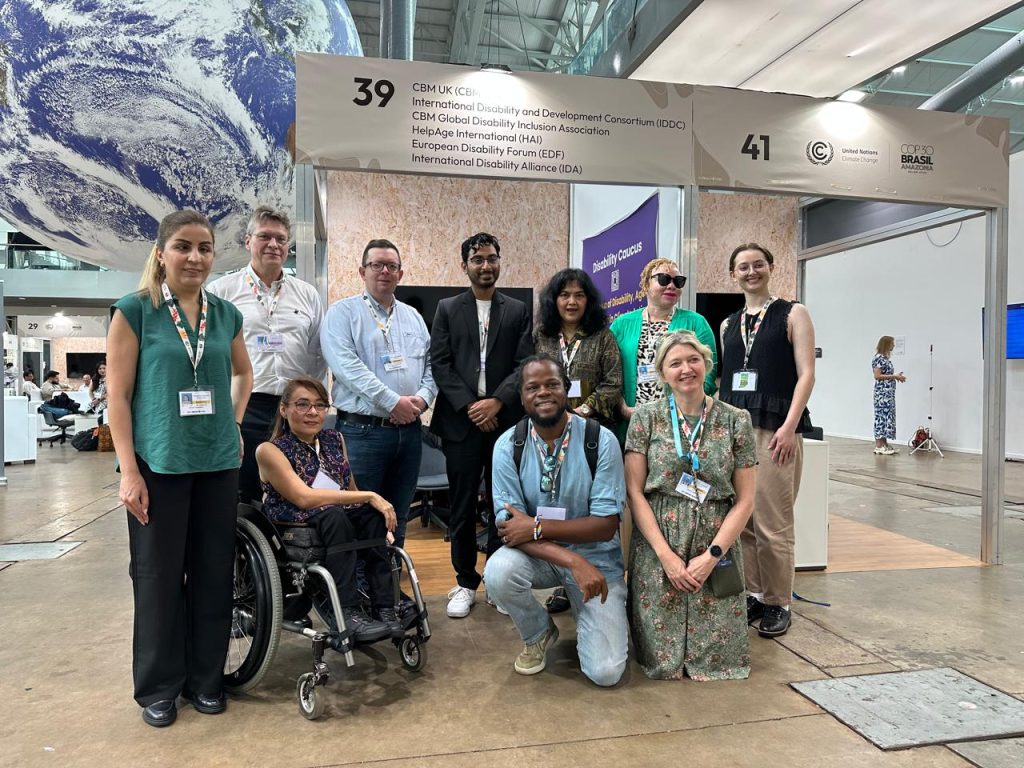
DRF’s global partners called for inclusive climate action at COP 30 in Belém.
Over the past two weeks, I was fortunate to participate in two important global forums: the United Nations Climate Change Conference (COP30) in Belém, Brazil, and the G20 in Johannesburg in South Africa. I write fortunate, because these events have become particularly challenging for ordinary citizens and grassroots leaders to participate in due to the prohibitive costs, physical and technological barriers that prevent both in-person and remote participation.
Despite the vast geographical distance between the two events, not to mention the different purposes and political arenas, it was interesting to observe that in both forums the disability community demanded the same thing: official recognition. This is particularly concerning that in 2025, almost 20 years after the Convention on the Rights of Persons with Disabilities (CRPD) was adopted — the disability community must demand something so fundamental.
For context, the G20 has 13 officially designated “Engagement Groups” while COP has nine “Constituencies”or “Major Groups”. These Groups represent civil society, business, and professional associations among others. Having status as an official Constituency or Engagement Group is significant as this grants access to the venues where negotiations occur and decisions are made. Furthermore, it allows officially recognised groups and constituencies to intervene and contribute to proposals under consideration. As such, the absence of recognition means persons with disabilities are not at the table where decisions are being made. While the officially recognised groups can meaningfully participate and influence conversations, persons with disabilities are still demanding a seat at the table and are left to navigate attitudinal, legal and physical barriers.
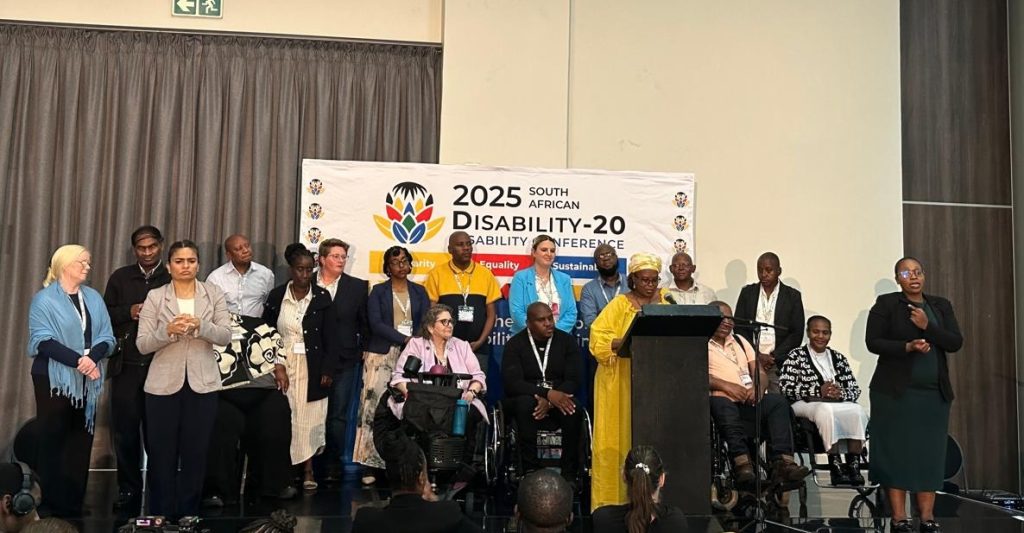
Disability-20 advocates gather in South Africa.
The question I heard repeatedly in both forums was: “Why do people with disabilities have to keep asking for things that everyone else has?”
This exclusion is not new. In fact, it is part of a historical pattern of disenfranchisement that relegates persons with disabilities to a ‘vulnerable group’ or ‘most vulnerable populations’, or, in the humanitarian sector, a ‘highly food insecure people’. This approach views persons with disabilities as inherently vulnerable due to their impairments and fails to recognize that it is systemic and structural barriers that render them “vulnerable”. This distinction is crucial and has significant implications on whether persons with disabilities are included or not. By focusing on the environment and processes—factors that are within their control,these important development and climate forums — G20 and COP — can invest in support systems, accommodations and inclusive service designs to ensure the meaningful participation of all persons with disabilities.
It is time for these multilateral institutions and States to set examples without delay and recognize persons with disabilities, a billion plus people worldwide, as a viable constituency. As Alex Msitshana, NCPD Chair, shared: “We don’t want to be footnotes anymore. We want to be part and centre of discussions that impact us.” Continual marginalization of the voices and perspectives of persons with disabilities undermines the governance and authority of intergovernmental processes at a time when they need to be enhanced and trust reinforced. Ensuring inclusion and recognition of persons with disabilities can be a step in broadening support and buy-in for these institutions and processes through greater inclusion.
To this end, the disability community has been organizing to challenge the status quo and be an active protagonist in these key global policy forums. With the support of the Disability Rights Fund (DRF) and allies, the Disability Climate Caucus is advocating for the United Nations Framework Convention on Climate Change (UNFCCC) to recognize the disability community as an official constituency. The Disability Climate Caucus brings together grassroots, regional OPDs and allies committed to center disability rights in climate change negotiations. The Caucus is currently awaiting a response regarding recognition as a formal constituency. Read the Disability Climate Caucus Policy Brief.
Likewise, since 2022 in Indonesia, DRF has been supporting OPDs to engage in G20 processes. This year, during the first G20 to take place on African soil, we were delighted to collaborate with IDA to supportOPDs through the African Disability Forum (ADF) the National Council for Persons with Disabilities (NCPD), and Disabled People South African (DPSA), to actively engage in the G20 process. And, as in the previous G20, the main advocacy demand has been for the recognition of the Disability-20 as an official Engagement Group and the establishment of a Disability Inclusion Working Group within the G20. Read the D-20 Call to Action.
At DRF, and our sister organization, the Disability Rights Advocacy Fund, we believe that participation of persons with disabilities is essential. That is why our investments also aim to ensure that people with disabilities show up in these spaces. Showing up challenges ableism, expands representation, and strengthens the collective power needed to influence global decisions that shape their lives. No more excuses: people with disabilities must no longer be ignored.
As Yeni Rosa, Chair of Indonesia Mental Health Association, put it: “Please recognize that we do exist. We are not just an add-on. We should be involved in all aspects of climate action. We should be in the centre of all the discussion because we are the first to be affected and last to be protected”.