What We Do
Our Impact.
By The Numbers
Since 2008, our support has enabled:
379
legislative, policy, and government program changes influenced by organizations of persons with disabilities
113
human rights and development monitoring reports submitted by organizations of persons with disabilities
7500
people trained through our peer and collective learning program
80%
of DRF grantees report increased involvement of marginalized persons with disabilities in their disability movements
“ If not for some of the interventions from organizations of persons with disabilities, the negative effect of COVID-19 on persons with disabilities would have been more disastrous in Nigeria.”
DRF grantee's interview in 2019-2022 external evaluation
How We Learn
Most systems and structures have barriers that hinder participation and leadership of persons with disabilities. Applied research, monitoring, and evaluation methods are no different. These traditional measurement systems tend to focus on the question: “What was our impact?”
At DRF, our inquiries start at a different point. We ask: “What are the questions and answers that matter to our grantees? What information will further the disability movement as a whole? These questions are grounded in the disability movement’s core call to action, “Nothing About Us Without Us.”
DRF applies a participatory, utilization-focused methods guided by feminist evaluation principles and a human-rights approach to research. By centering the values that drive the disability movement and DRF’s intersectional approach, our learning can be guided by the needs of our grantees and the wider disability movement.
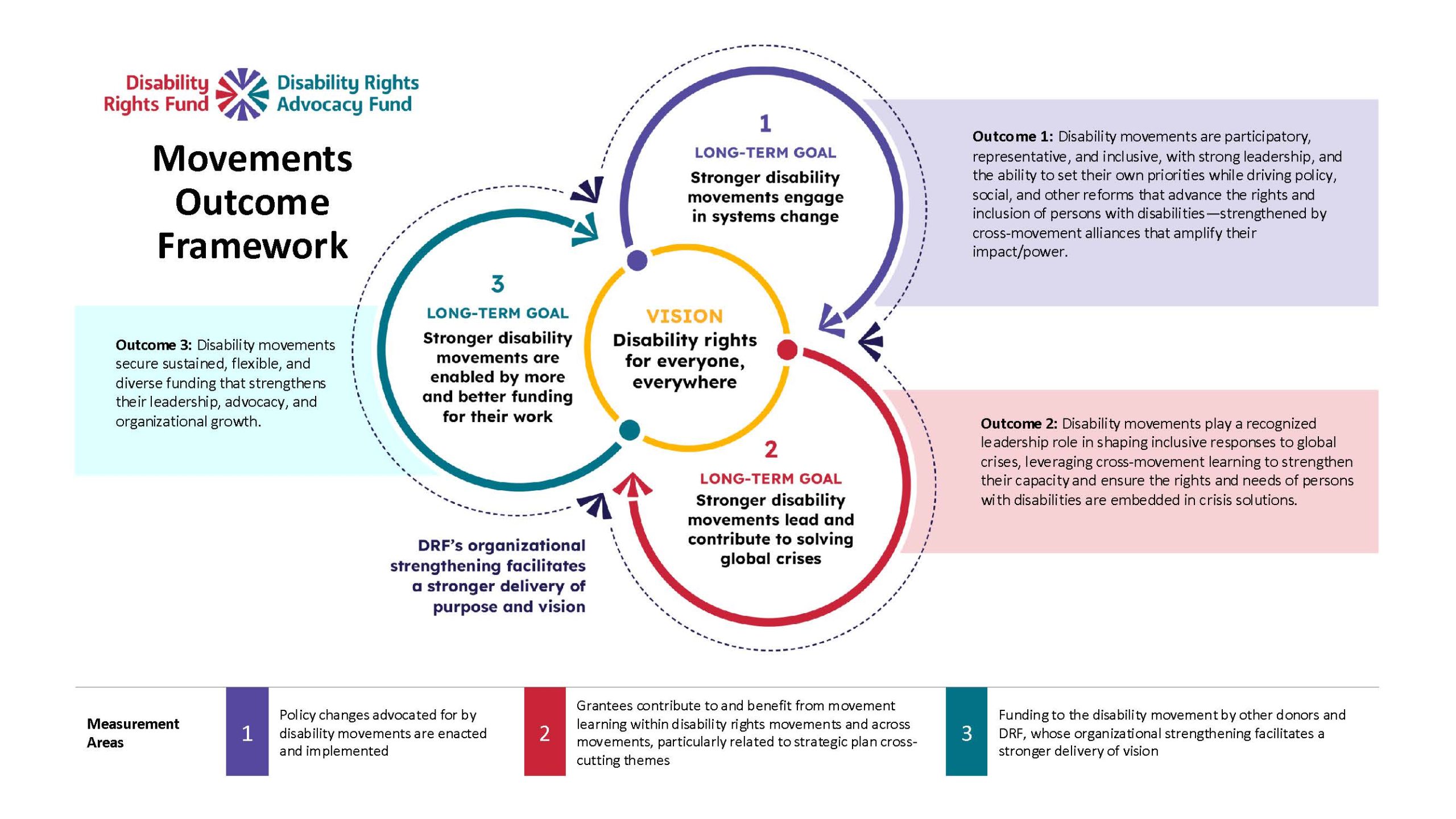
Movement Outcomes Framework
Learning with Partners
DRF’s learning and evaluation system is guided by key principles, including ensuring mutual benefit for both DRF and our sister fund, the Disability Rights Advocacy Fund (DRAF), and disability movements. It is vital that the evaluation and learning data collected by our organizations provide meaningful value to our grantees.
Melanie Kawano-Chiu
Director of Monitoring, Evaluation, Accountability, and Learning (MEAL)“Privilege and access, at their core, are about the ability to make choices. As a participatory grantmaker, DRF gets to choose where it starts its MEAL practices. We intentionally shift this locus of power to persons with disabilities. This re-orientation is not a nice-to-have. It is the very foundation of the effectiveness of DRF and the relevance of our learning practices.”
Our Monitoring, Evaluation, Accountability and Learning (MEAL) Reports
“In countries where DRF/DRAF are not present, the movement is not as inclusive.” — BLE Evaluation Report, 2020
Periodic independent external evaluations have allowed us to reflect on achievements, gaps, and opportunities and to change course, as needed. To date, five independent evaluations have shown how a participatory grantmaker has a critical role in furthering the rights of persons with disabilities.
- 2023 Universalia DRF/DRAF Utilization-Focused and Feminist Principles Evaluation
- 2020 BLE Solutions DRF/DRAF Participatory Evaluation
- 2020 Leadership Strategies Pacific Island Countries Evaluation
- 2015 Universalia DRF/DRAF Learning Evaluation
- 2013 Universalia DRF/DRAF Initial OECD-DAC Criteria Evaluation